

Bellows valves: The safe solution for leak-tight processes
Anyone who needs their system to be completely leak-proof will find it hard to ignore the bellows valve. Whether in the chemical industry, in power plants, or in sensitive areas of pharmaceutical production—as soon as toxic, aggressive, or high-purity media are involved, a conventional valve quickly becomes a risk. In this article, we show how a bellows valve works, why it is a genuine safety valve, and in which applications it becomes indispensable.
What is a bellows valve?
A bellows valve is a special industrial valve with a tightly welded metal bellows that hermetically seals the area between the valve stem and the housing. This ensures that no medium can escape to the outside – even under heavy use or with aggressive media. The term “bellows” describes the flexible metal membrane that can expand and contract like an accordion. It is typically made of stainless steel and welded on both sides. The design completely eliminates moving sealing points.
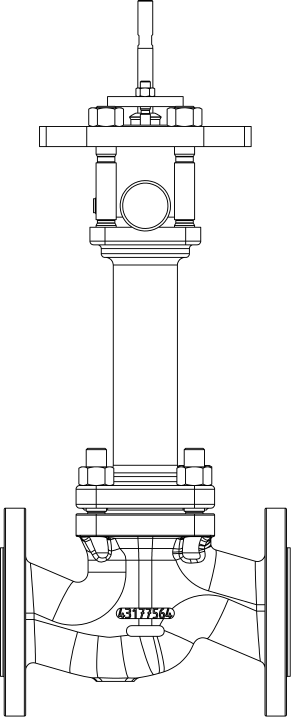
How does a bellows valve work?
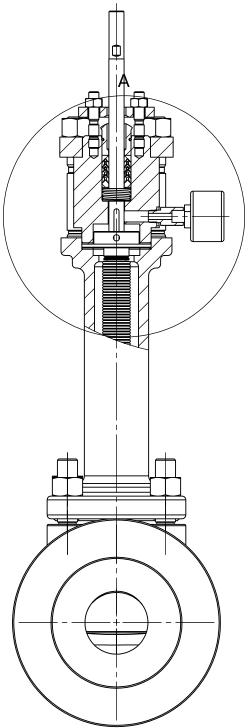
Inside the valve, the bellows seals it off from the atmosphere. It is firmly connected to the stem and the bonnet. When the stem moves—i.e., when the valve opens or closes—the bellows expands or contracts accordingly. The medium remains 100% enclosed.
This design replaces the classic stuffing box and makes the valve maintenance-free and extremely tight. The bellows valve is therefore ideal for processes with the highest safety and environmental compatibility requirements.
To ensure that the valve remains reliably sealed even with frequent use, the bellows must have a defined length. As a rule of thumb, this should be around ten times the stroke length. This allows for up to 200,000 switching cycles without the need for maintenance or readjustment.
What types of bellows valves are there?
Different designs are used depending on the area of application:
- Single-wall bellows – for standard applications with moderate risk.
- Double-wall bellows – with additional safety barrier for toxic or carcinogenic media.
- Combination with gland – for TA-Luft-compliant applications with double seals.
Especially in extreme process conditions, e.g., polymerizing, highly viscous, or solids-laden media, it makes sense to combine them with additional sealing systems such as safety stuffing boxes.
Designs & drive types of bellows valves
The designs of bellows valves are as diverse as their areas of application. Depending on the medium, temperature, pressure level, or degree of automation, the control valve must be optimally suited to the system. The right combination of design, nominal diameter, and actuator is crucial for safe, efficient, and long-lasting operation.
Drive types: Manual or automated
Bellows valves can be operated in various ways – from classic to fully automated:
| Drive Type | Application | |
|---|---|---|
| Hand-rowed | The simple, cost-effective solution for systems with occasional operating requirements |  |
| Pneumatic | Ideal for fast switching and precise control, e.g., in process control systems |  |
| Electric | For automatic processes with precise control and remote control |  |
| Hydraulic | Used for high actuating forces – for example, with large nominal diameters or high-pressure systems |  |
The choice of drive depends heavily on the intended use and the requirements in terms of response time, controllability, and degree of automation.
Nominal diameters: For small and large volume flows
Bellows valves also offer a great deal of flexibility in terms of sizing. Typical nominal diameters (DN) range from DN 15 to DN 300. They are adapted to:
- the desired volume flow
- the operating pressure
- the viscosity and properties of the medium
This allows bellows valves to be integrated safely and precisely into both compact laboratory applications and large-scale industrial plants.
Why is the bellows valve a safety-relevant valve?
When processing toxic, explosive, or carcinogenic substances, no medium must escape to the outside. Bellows valves ensure exactly that. Thanks to the metal-tight separation between the medium and the environment, they meet even the most stringent environmental requirements such as TA-Luft – without the need for regular retightening or seal replacement.
Good to know: TA-Luft explicitly recommends the use of bellows seals or equivalent sealing systems for carcinogenic or toxic media. While classic stuffing boxes need to be readjusted after a short time, metallic bellows remain stably sealed for years. Provided, of course, that they are correctly dimensioned and installed.
The advantages of a bellows valve at a glance
- Extremely low leakage values
- Maintenance-free – no need to readjust the packing
- Complies with TA-Luft requirements
- Suitable for high and low temperatures
- Long service life (up to 200,000 switching cycles)
- No media loss, no emissions
- Corrosion-resistant and robust against temperature fluctuations
In which industries are bellows valves used?
Bellows valves are used wherever absolute tightness, high operational reliability, and resistance to aggressive, toxic, or sensitive media are required. Typical industries and applications:
Chemical industry
- Media: e.g. chlorine gas, sulfuric acid, alkalis
- Requirements: high corrosion resistance, emission-free, personnel protection
Pharmaceutical industry
Pharmaceutical industry
- Media: toxic, sterile, or sensitive liquids
- Requirements: contamination-free operation, CIP/SIP cleaning, cleanroom suitability
Petrochemicals & refineries
Petrochemicals & Refineries
- Media: flammable, explosive gases or liquids
- Requirements: ATEX-compliant seal, high temperature and pressure resistance
Environmental & process engineering
Environmental & Process Engineering
- Media: process water, wastewater, aggressive chemicals
- Requirements: durability, chemical resistance, safe continuous operation
Conclusion
Bellows valves are the first choice when it comes to safe, leak-tight, and maintenance-free shut-off or control valves. They meet the highest requirements for tightness and environmental standards—and do so for many years.
Thanks to intelligent design, high-quality materials, and strict standards (e.g., TA-Luft), they reliably secure processes—even under extreme conditions. Whether dealing with aggressive media, high temperatures, or sensitive substances, you can rely on the bellows valve.
Important standards include, for example, DIN EN 12266 for leak testing and ASME B16.34 for design requirements. Industry-specific standards such as TA-Luft for emission control or ATEX for explosion protection may also be relevant. Compliance with such standards is usually documented in technical data sheets.
Bellows valves ensure minimal leakage losses and thus optimized process reliability thanks to their high tightness and reliable function. They reduce maintenance costs and downtime, which increases the overall efficiency of a plant. Their long service life also contributes to their cost-effectiveness.